A game for the table
Print, fold, roll.
Three dice, a pair of players, and a circle of surprising advantages. Make your own set with labelled glue tabs, then take turns choosing first.
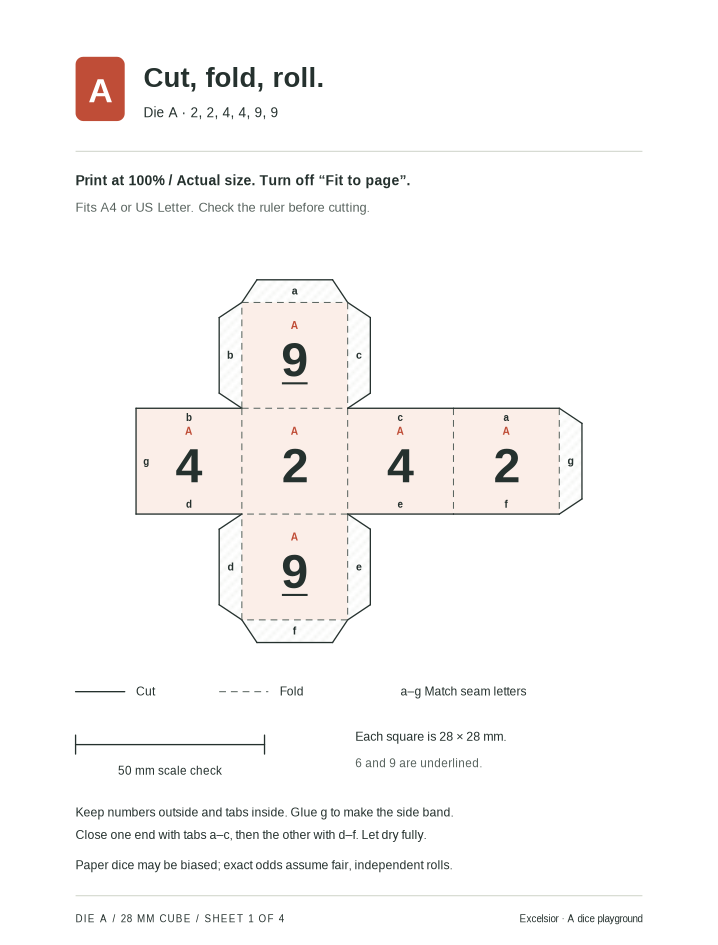
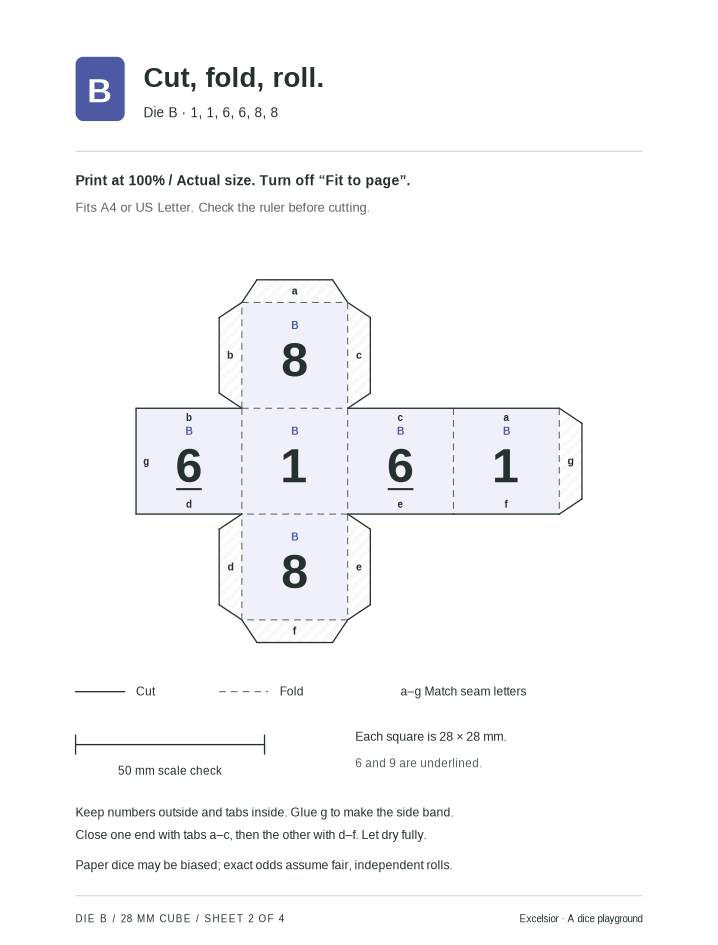
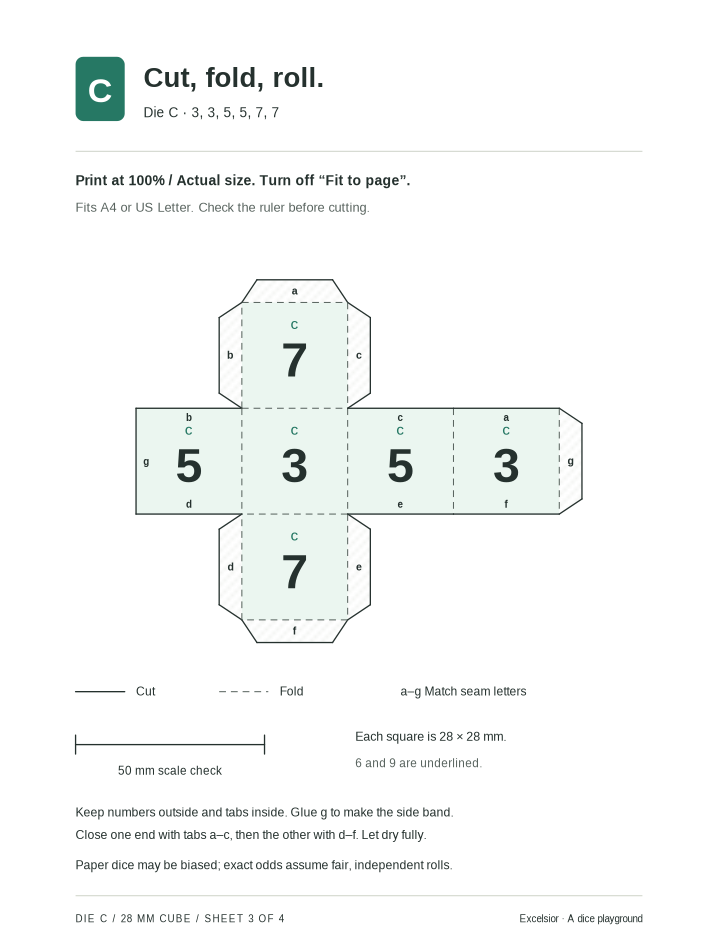
Print at 100% / Actual size. Use A4 or US Letter, switch off “Fit to page” and browser headers/footers, then measure the 50 mm ruler. Each cube has 28 mm edges. The PDF pages contain 190 × 250 mm artwork.
Make the set
- Cut along the solid outline, keeping all seven tabs.
- Pre-fold all dashed lines with the numbers outside.
- Glue each lettered tab inside its matching lettered edge.
- Join g to make the four-face side band. Close one end with tabs a–c, then the other with d–f.
- Use a thin layer of glue and let the dice dry fully before rolling.
Play 12 rounds
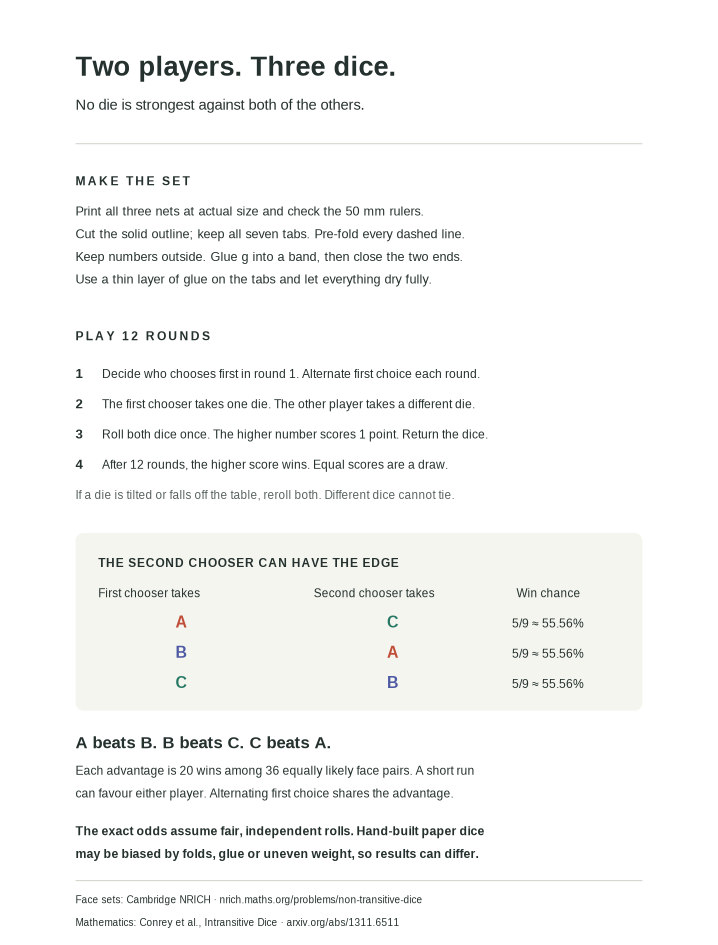
- Play 12 rounds. Decide who chooses first in round 1, then alternate first choice each round.
- The first chooser takes one die; the other chooses a different die from the two remaining.
- Roll both dice once. The higher number scores 1 point. Return the dice after every round.
- If a die is tilted or falls off the table, reroll both. Distinct dice in this set cannot tie.
- After 12 rounds, the higher score wins. Equal scores are a draw.
Why choosing second helps
Whichever die is chosen first, one remaining die beats it with probability 20/36 = 5/9 ≈ 55.56%, assuming fair independent rolls. The second chooser must pick that counter-die to get the advantage. Alternating first choice gives each player the same number of opportunities.
| First choice | Second choice | Ideal win chance |
|---|---|---|
| A | C | 5/9 |
| B | A | 5/9 |
| C | B | 5/9 |
These rules compare one roll of each die. Adding several rolls is a different game and can change which die has the advantage.
Hand-built paper dice may be biased by folds, glue or uneven weight. The exact 5/9 probability assumes perfectly fair independent rolls; your paper results need not match it. The digital 36-outcome table still gives the exact result for that mathematical model. An advantage is not a guarantee: either die can win a short run.
Individual sheets, sources and accessible face lists
Download or open the original vectors: Die A: 2, 2, 4, 4, 9, 9 · Die B: 1, 1, 6, 6, 8, 8 · Die C: 3, 3, 5, 5, 7, 7 · Two-player guide.
The face sets come from Cambridge NRICH’s Non-Transitive Dice problem; our A is its green die, B its red die, C its blue die. The cube nets, illustration and twelve-round rules are newly made by Excelsior. Exact one-roll probabilities were checked by enumerating all 36 face pairs. Cube folds and tab pairings were checked geometrically; a physical prototype has not been assembled.
Die A · 2, 2, 4, 4, 9, 9
Die B · 1, 1, 6, 6, 8, 8
Die C · 3, 3, 5, 5, 7, 7
Two-player guide